The Woman in Black
The Woman in Black is a chilling, masterfully crafted modern Gothic novel that explores the destructive power of grief and the inescapability of the past. It offers students rich opportunities for word-level analysis and thematic exploration, making it a highly rewarding text for GCSE Literature.
Study Notes
Overview
Susan Hill's The Woman in Black (1983) is a modern novel written in the style of a traditional Victorian ghost story. For GCSE Literature candidates, this text is a goldmine for AO2 (analysis of writer's methods). Hill uses dense, sensory language, a suffocating isolated setting, and a carefully structured frame narrative to build tension and explore profound psychological and supernatural themes. Examiners are looking for candidates who can move beyond simply retelling the plot to analyse how Hill creates fear, and why she explores themes of unacknowledged grief, isolation, and revenge within an Edwardian context.
Plot/Content Overview
- Christmas Eve (The Frame Narrative): Older Arthur Kipps is asked to tell a ghost story by his family. Traumatised, he refuses, deciding instead to write down his experiences to exorcise his demons.
- The Journey North: Young Arthur, an ambitious London solicitor, travels to the remote town of Crythin Gifford to settle the estate of the reclusive Mrs Alice Drablow.
- The Funeral: Arthur attends Mrs Drablow's funeral, where he first sees the terrifying, wasted figure of the Woman in Black. The locals are noticeably terrified but refuse to explain why.
- Eel Marsh House: Arthur travels across the Nine Lives Causeway to the isolated Eel Marsh House. He experiences supernatural phenomena: the sound of a pony trap crashing in the marsh and a child crying, though nothing is there.
- The Haunting: Arthur finds letters revealing that Jennet Humfrye (Mrs Drablow's sister) was forced to give up her illegitimate son, Nathaniel, to Mrs Drablow. Nathaniel died in the marsh. Jennet died of a wasting disease, swearing revenge.
- The Climax: After being rescued by Mr Daily, Arthur returns to London, marries Stella, and has a child. However, at a park in London, the Woman in Black appears. She steps in front of a pony trap carrying Stella and their baby, causing a fatal crash. The ghost has taken her final revenge.
Themes
Theme 1: Grief and its Destructive Consequences
Hill presents grief not as a natural healing process, but as a corrosive, monstrous force when it is denied or suppressed. Jennet Humfrye's grief for her lost child, Nathaniel, is never publicly acknowledged due to the social stigma of illegitimacy in the Edwardian era. This unacknowledged sorrow curdles into a vengeful, eternal hatred that targets the innocent.
Key Quotes:
- "mad with grief and mad with anger and a desire for revenge" (Chapter 11) - Hill uses repetition of "mad" to emphasize how Jennet's emotional suffering has entirely consumed her sanity.
- "a desperate, yearning trail" (Chapter 9) - The adjective "yearning" highlights the profound maternal loss that drives the haunting, making Jennet a tragic figure as well as a terrifying one.
Theme 2: The Supernatural vs. The Psychological
Hill maintains a deliberate ambiguity between literal ghosts and psychological breakdown. While the ghost has physical effects (causing deaths), Arthur's terror is deeply psychological. The novel explores how trauma fragments the mind.
Key Quotes:
- "I was not myself" (Chapter 6) - This simple phrase captures the psychological horror of the novel; Arthur is losing his grip on his rational, London-solicitor identity.
- "a malevolence and enmity and passionate emotion" (Chapter 4) - The polysyndeton (repetition of 'and') creates an overwhelming, breathless sense of the ghost's pure, concentrated hatred.
Theme 3: Isolation and Vulnerability
Isolation in the novel is both physical (Eel Marsh House cut off by the tide) and emotional (Arthur's inability to communicate his trauma). The setting acts as a crucible, stripping away Arthur's modern, rational defenses.
Key Quotes:
- "remote, cut off" (Chapter 5) - The physical isolation of Eel Marsh House mirrors Arthur's growing psychological detachment from the rational world.
- "we are all of us alone" (Chapter 1) - Older Arthur's reflection in the frame narrative demonstrates how his experience has permanently altered his worldview, leaving him emotionally isolated even in a crowded room.
Character Analysis
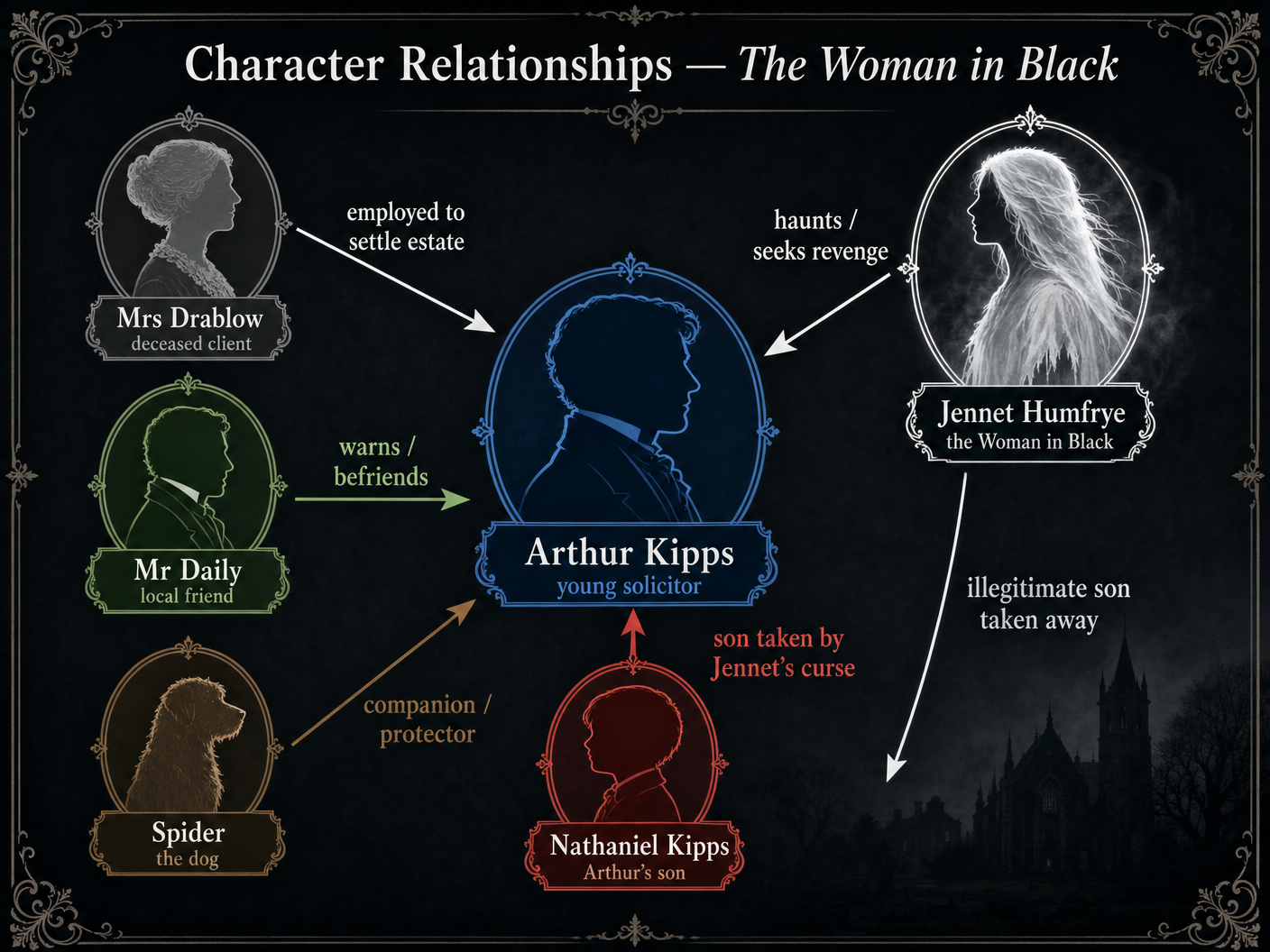
Arthur Kipps
Role: The protagonist and narrator; our lens into the horror.
Key Traits: Initially rational, arrogant, and dismissive of superstition. Ultimately broken, traumatised, and stripped of his hubris.
Character Arc: Arthur moves from a confident, rational Londoner to a man entirely broken by forces he cannot comprehend or control. His journey represents the defeat of modern rationality by ancient, primal emotions.
Essential Quotes:
- "I did not believe in ghosts" (Chapter 3) - Establishes his initial rational hubris.
- "my whole body was trembling, my mouth dry" (Chapter 6) - The physical manifestation of his psychological breakdown.
Jennet Humfrye (The Woman in Black)
Role: The antagonist; the physical manifestation of unacknowledged grief and revenge.
Key Traits: Wasted, malevolent, obsessed, tragic.
Character Arc: She transitions from a victim of rigid social morality (forced to give up her illegitimate child) to a supernatural perpetrator of violence against children.
Essential Quotes:
- "a wasted face" (Chapter 4) - The adjective "wasted" suggests both physical decay from disease and the emotional wasting away of her humanity.
- "she directed the purest, evilest hatred and loathing" (Chapter 4) - The superlative "evilest" emphasizes the absolute, concentrated nature of her malice.
Writer's Methods
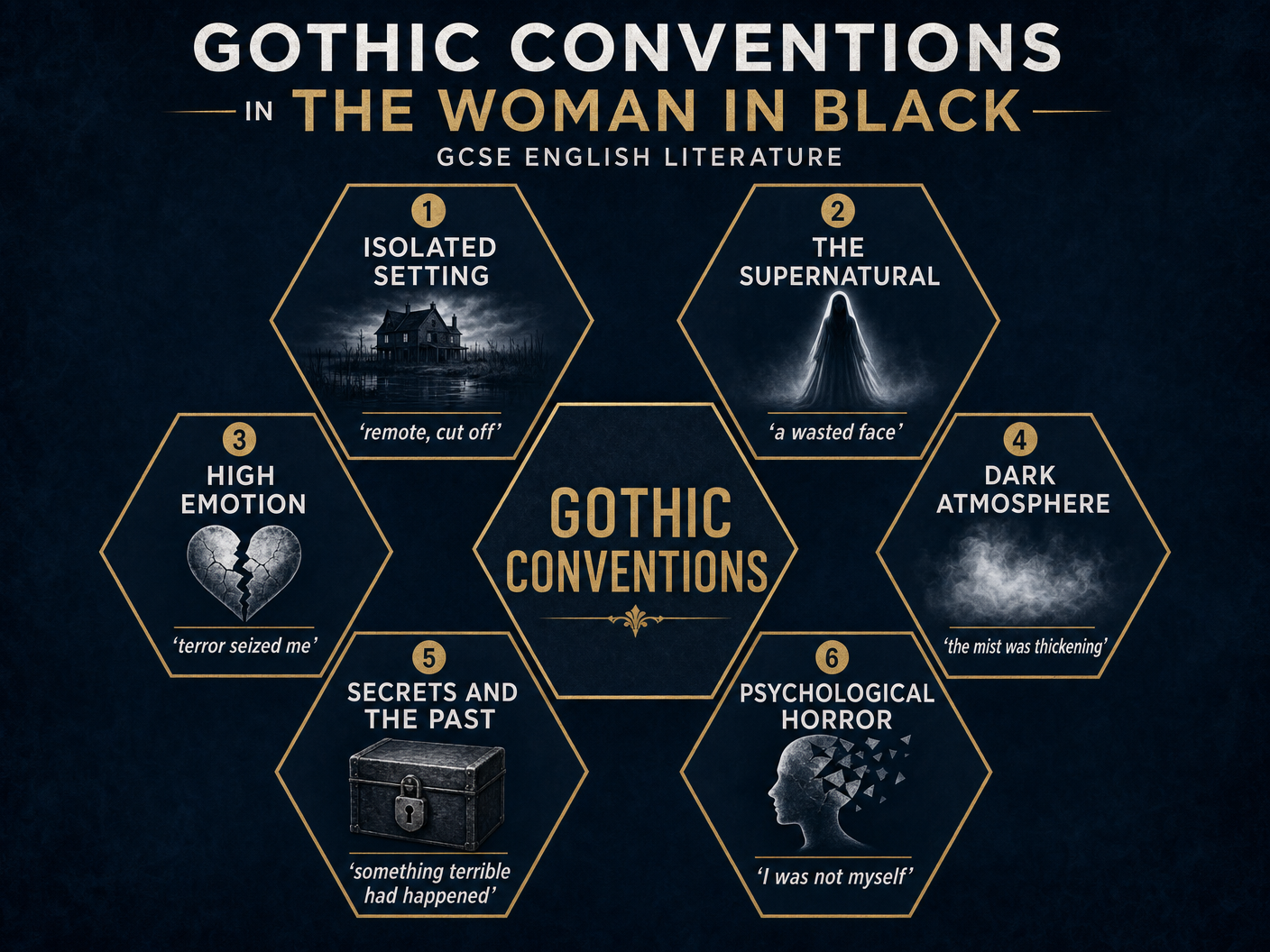
1. The Frame Narrative: By starting the novel with an older, traumatised Arthur, Hill creates immediate anticipatory dread. We know he survives, but we know he is broken. This structural choice also highlights the theme of memory and the inescapability of the past.
2. Sensory Language and Setting: Hill uses pathetic fallacy extensively. The sea frets and fogs of Crythin Gifford blind and disorientate Arthur, symbolizing his inability to 'see' or understand the supernatural reality. The use of present participles (e.g., "the mist was thickening") makes the environment feel active and hostile.
3. Auditory Horror: Hill often uses sound rather than sight to create terror. The sound of the pony trap sinking in the marsh is heard, not seen. This forces the reader (and Arthur) to imagine the horror, which is often more frightening than witnessing it directly.
Context
- The Victorian Ghost Story Tradition: Although written in 1983, the novel deliberately pastiches Victorian literature (like Dickens or M.R. James). Examiners expect you to note that Hill is consciously playing with these established Gothic tropes.
- Edwardian Social Morality: Jennet's tragedy is rooted in the harsh social stigma against illegitimacy. She had no legal rights to her own child. Understanding this context elevates Jennet from a simple monster to a victim of patriarchal, rigid social structures.
Listen to our comprehensive audio guide for more detailed analysis:
Visual Resources
2 diagrams and illustrations
Interactive Diagrams
1 interactive diagram to visualise key concepts
Conceptual Flow Outline
The Psychological Decline of Arthur Kipps
Worked Examples
2 detailed examples with solutions and examiner commentary
Practice Questions
Test your understanding — click to reveal model answers
Explore how Hill presents the theme of revenge in The Woman in Black.
Hint: Consider the origins of Jennet's revenge (loss of her child), how her revenge manifests (targeting other children), and whether her revenge is ever satisfied.
How does Hill use setting to create tension and fear in the novel?
Hint: Focus on Eel Marsh House, the Nine Lives Causeway, and the use of weather (fog/frets).